01
The challenge: two offerings, two buyers, two buying journeys
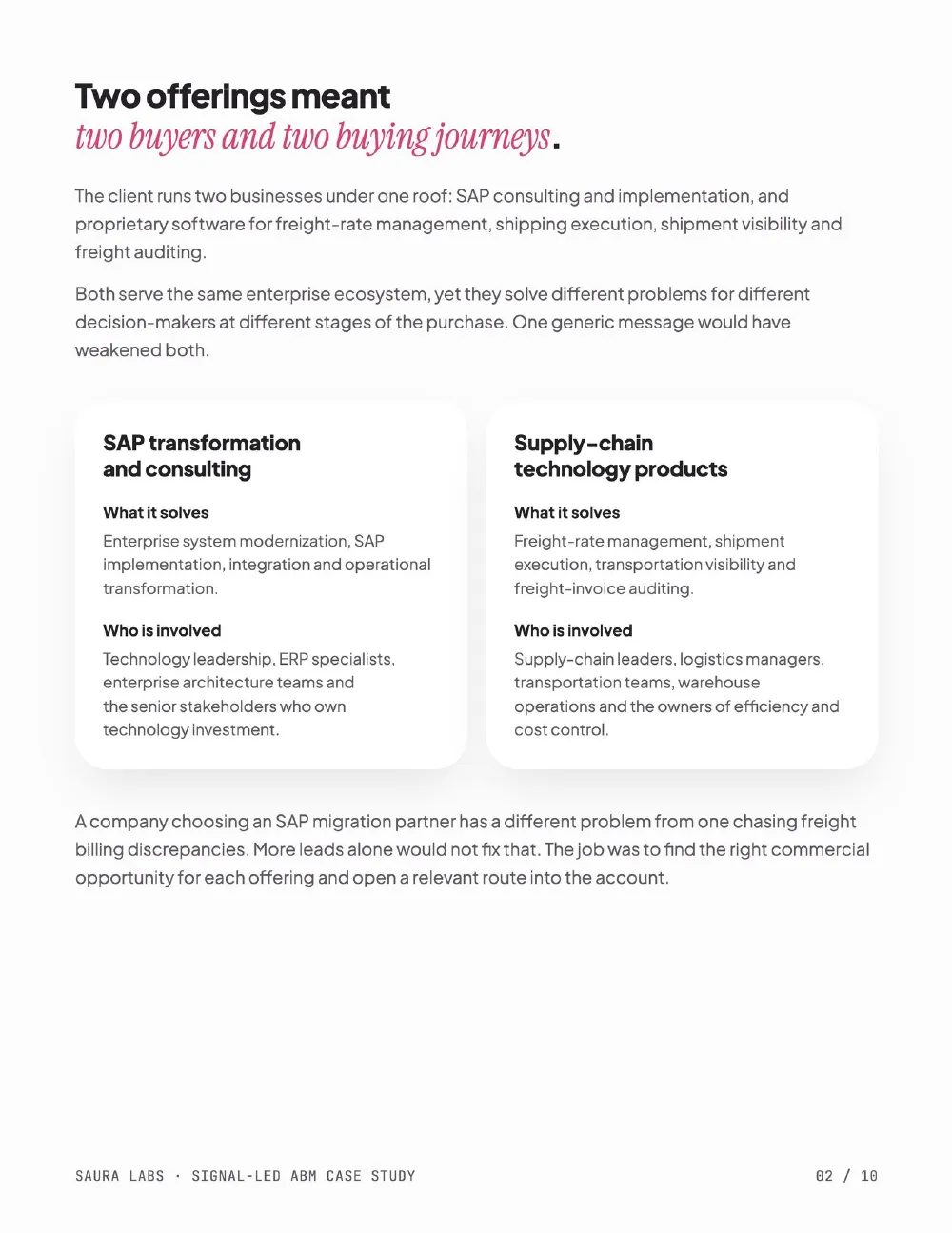
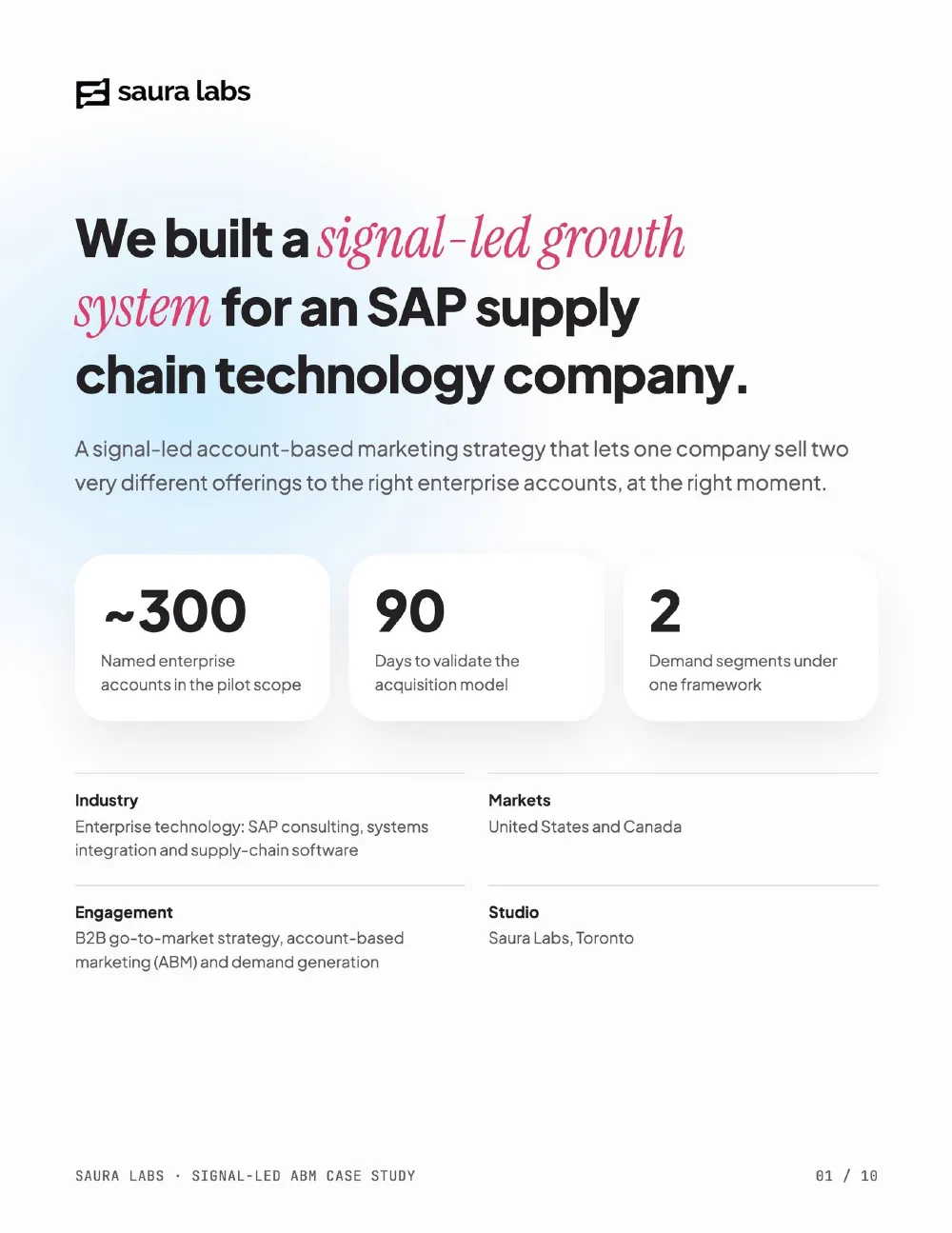
The client runs two businesses under one roof: SAP consulting and implementation, and proprietary software for freight-rate management, shipping execution, shipment visibility and freight auditing.
Both serve the same enterprise ecosystem, yet they solve different problems for different decision-makers at different stages of the purchase. One generic message would have weakened both.
SAP transformation and consulting
- What it solves
- Enterprise system modernization, SAP implementation, integration and operational transformation.
- Who is involved
- Technology leadership, ERP specialists, enterprise architecture teams and the senior stakeholders who own technology investment.
Supply-chain technology products
- What it solves
- Freight-rate management, shipment execution, transportation visibility and freight-invoice auditing.
- Who is involved
- Supply-chain leaders, logistics managers, transportation teams, warehouse operations and the owners of efficiency and cost control.
A company choosing an SAP migration partner has a different problem from one chasing freight billing discrepancies. More leads alone would not fix that. The job was to find the right commercial opportunity for each offering and open a relevant route into the account.
02
Why firmographics were not enough: fit × signal × timing
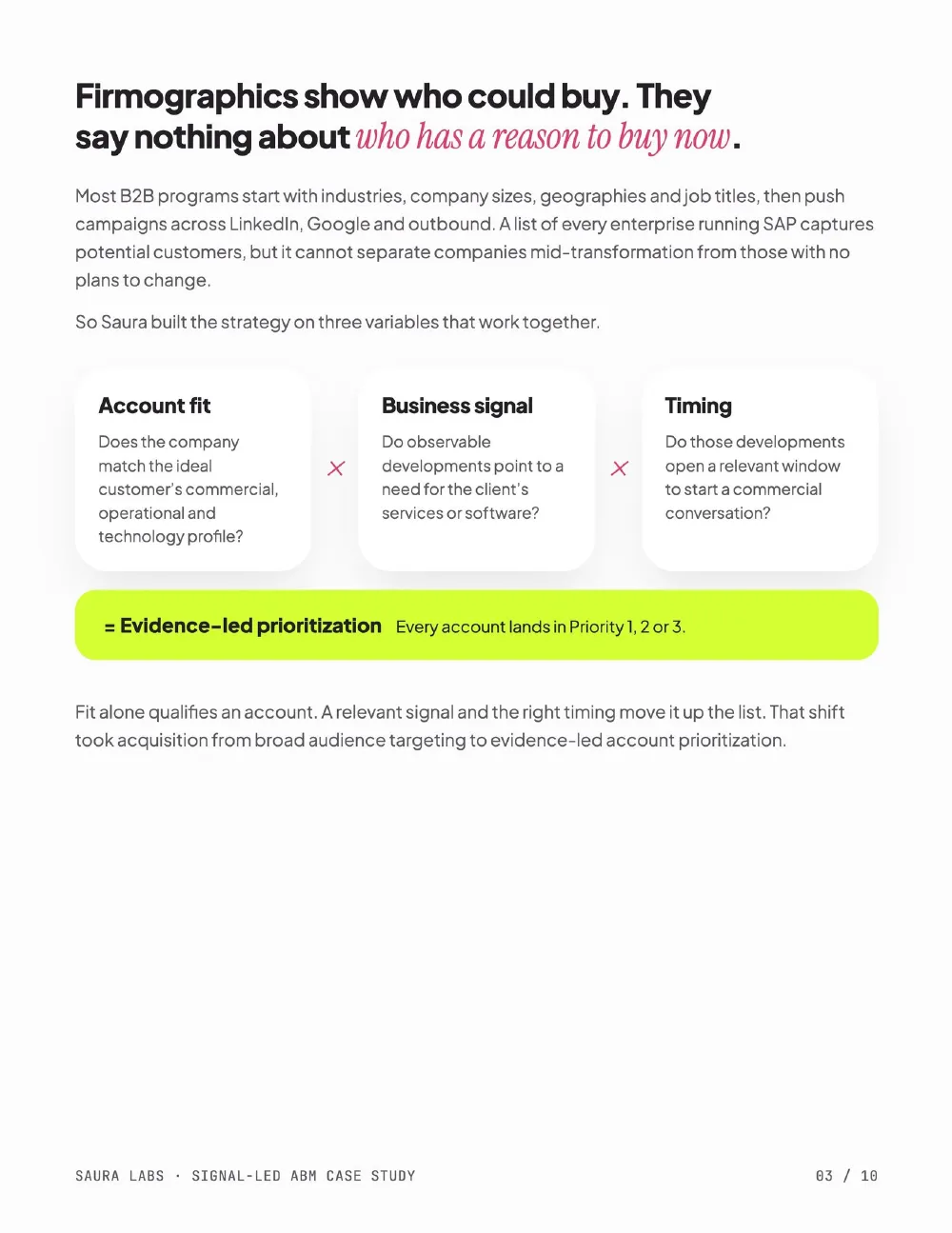
Most B2B programmes start with industries, company sizes, geographies and job titles, then push campaigns across LinkedIn, Google and outbound. A list of every enterprise running SAP captures potential customers, but it cannot separate companies mid-transformation from those with no plans to change. Firmographics show who could buy. They say nothing about who has a reason to buy now.
So the strategy is built on three variables that work together.
- Fit
Account fit
Does the company match the ideal customer's commercial, operational and technology profile?
- Signal
Business signal
Do observable developments point to a need for the client's services or software?
- Timing
Timing
Do those developments open a relevant window to start a commercial conversation?
Fit alone qualifies an account. A relevant signal and the right timing move it up the list. That shift took acquisition from broad audience targeting to evidence-led account prioritization, with every account landing in Priority 1, 2 or 3.
03
One portfolio, two demand segments
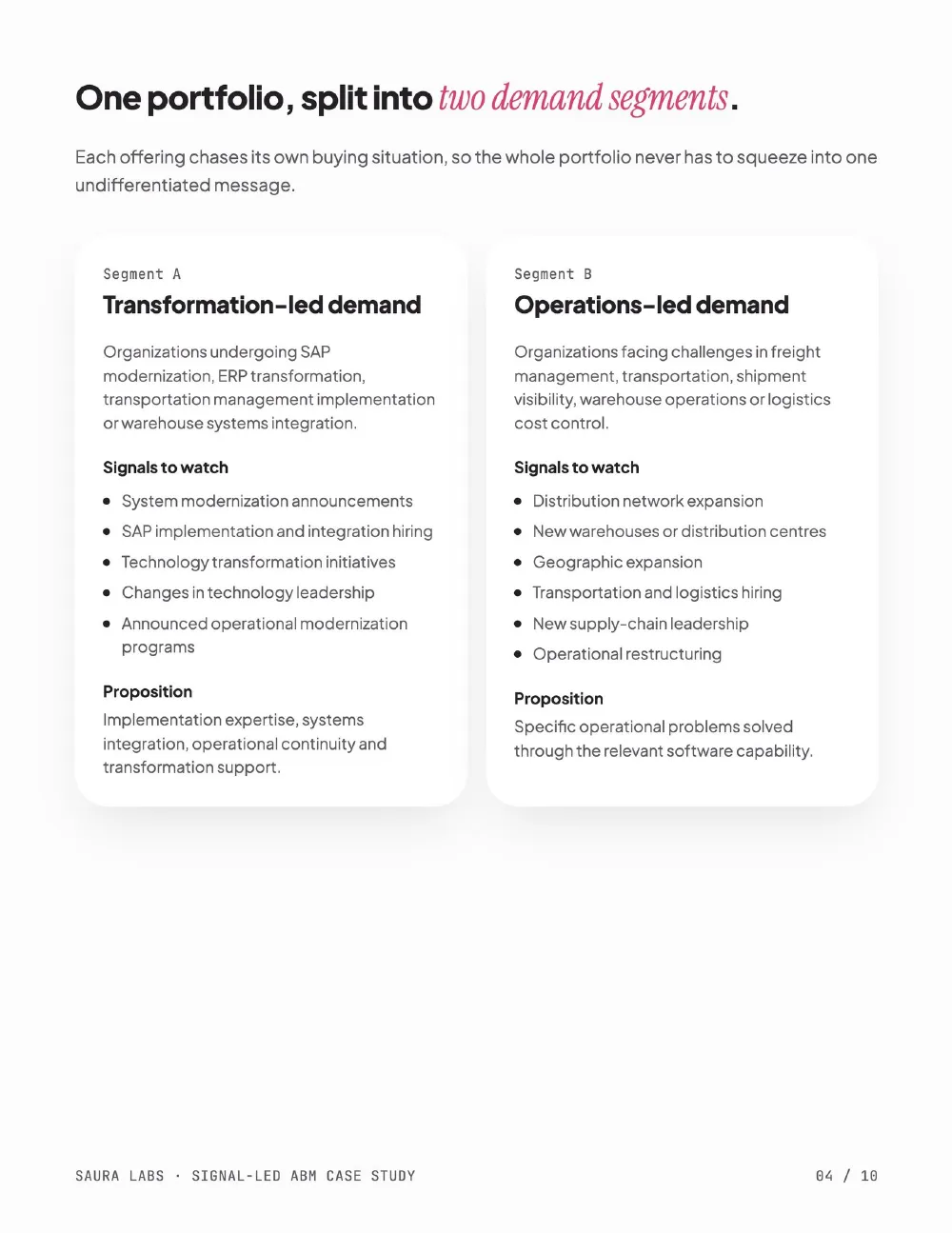
Each offering chases its own buying situation, so the whole portfolio never has to squeeze into one undifferentiated message.
Segment A
Transformation-led demand
- Who
- Organizations undergoing SAP modernization, ERP transformation, transportation management implementation or warehouse systems integration.
- Proposition
- Implementation expertise, systems integration, operational continuity and transformation support.
Signals to watch
- System modernization announcements
- SAP implementation and integration hiring
- Technology transformation initiatives
- Changes in technology leadership
- Announced operational modernization programmes
Segment B
Operations-led demand
- Who
- Organizations facing challenges in freight management, transportation, shipment visibility, warehouse operations or logistics cost control.
- Proposition
- Specific operational problems solved through the relevant software capability.
Signals to watch
- Distribution network expansion
- New warehouses or distribution centres
- Geographic expansion
- Transportation and logistics hiring
- New supply-chain leadership
- Operational restructuring
04
Every signal is a reason to investigate, never proof of intent
Static firmographic databases were only the starting point. The model layers in observable developments: corporate announcements, hiring activity, technology transformation news, leadership appointments, expansion announcements and other public business information.
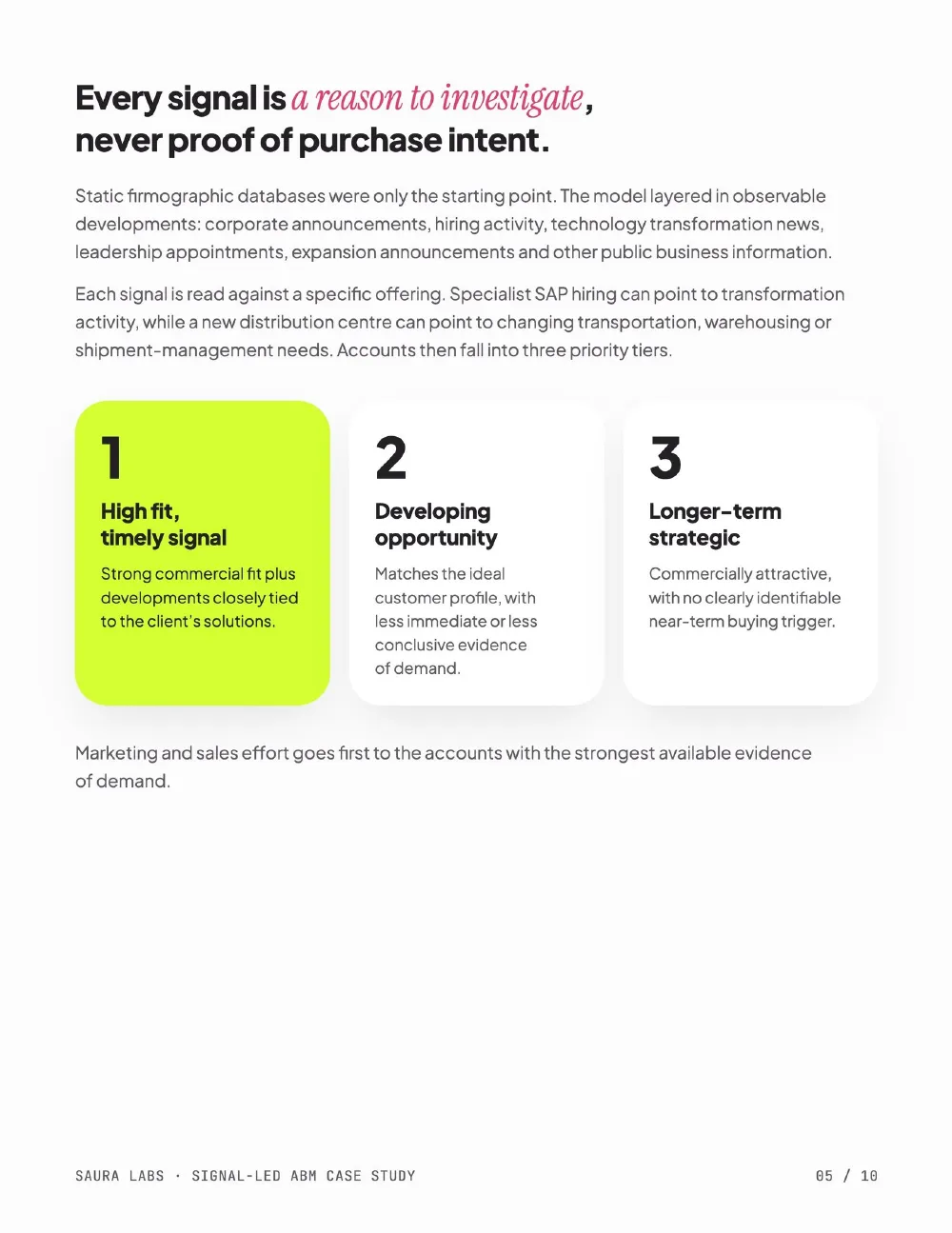
Each signal is read against a specific offering. Specialist SAP hiring can point to transformation activity, while a new distribution centre can point to changing transportation, warehousing or shipment-management needs. Accounts then fall into three priority tiers.
- Priority 1
High fit, timely signal
Strong commercial fit plus developments closely tied to the client's solutions.
- Priority 2
Developing opportunity
Matches the ideal customer profile, with less immediate or less conclusive evidence of demand.
- Priority 3
Longer-term strategic
Commercially attractive, with no clearly identifiable near-term buying trigger.
Marketing and sales effort goes first to the accounts with the strongest available evidence of demand.
05
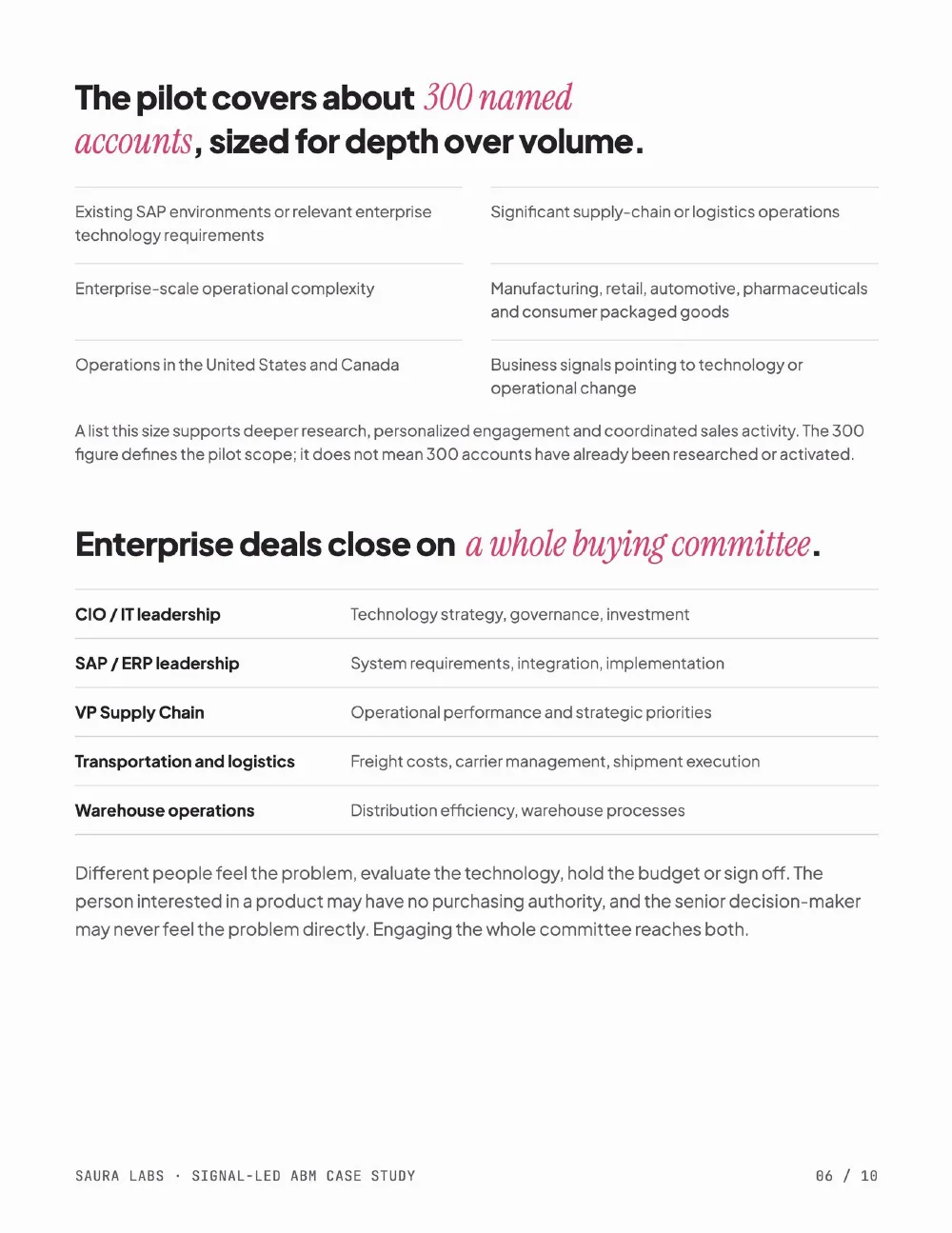
A pilot of about 300 named accounts, sized for depth over volume
Accounts in scope share these traits:
| Technology profile | Operational profile |
|---|---|
| Existing SAP environments or relevant enterprise technology requirements | Significant supply-chain or logistics operations |
| Enterprise-scale operational complexity | Manufacturing, retail, automotive, pharmaceuticals and consumer packaged goods |
| Operations in the United States and Canada | Business signals pointing to technology or operational change |
A list this size supports deeper research, personalized engagement and coordinated sales activity.
The 300 figure defines the pilot scope; it does not mean 300 accounts have already been researched or activated.
06
Enterprise deals close on a whole buying committee
| Stakeholder | What they care about |
|---|---|
| CIO / IT leadership | Technology strategy, governance, investment |
| SAP / ERP leadership | System requirements, integration, implementation |
| VP Supply Chain | Operational performance and strategic priorities |
| Transportation and logistics | Freight costs, carrier management, shipment execution |
| Warehouse operations | Distribution efficiency, warehouse processes |
Different people feel the problem, evaluate the technology, hold the budget or sign off. The person interested in a product may have no purchasing authority, and the senior decision-maker may never feel the problem directly. Engaging the whole committee reaches both.
07
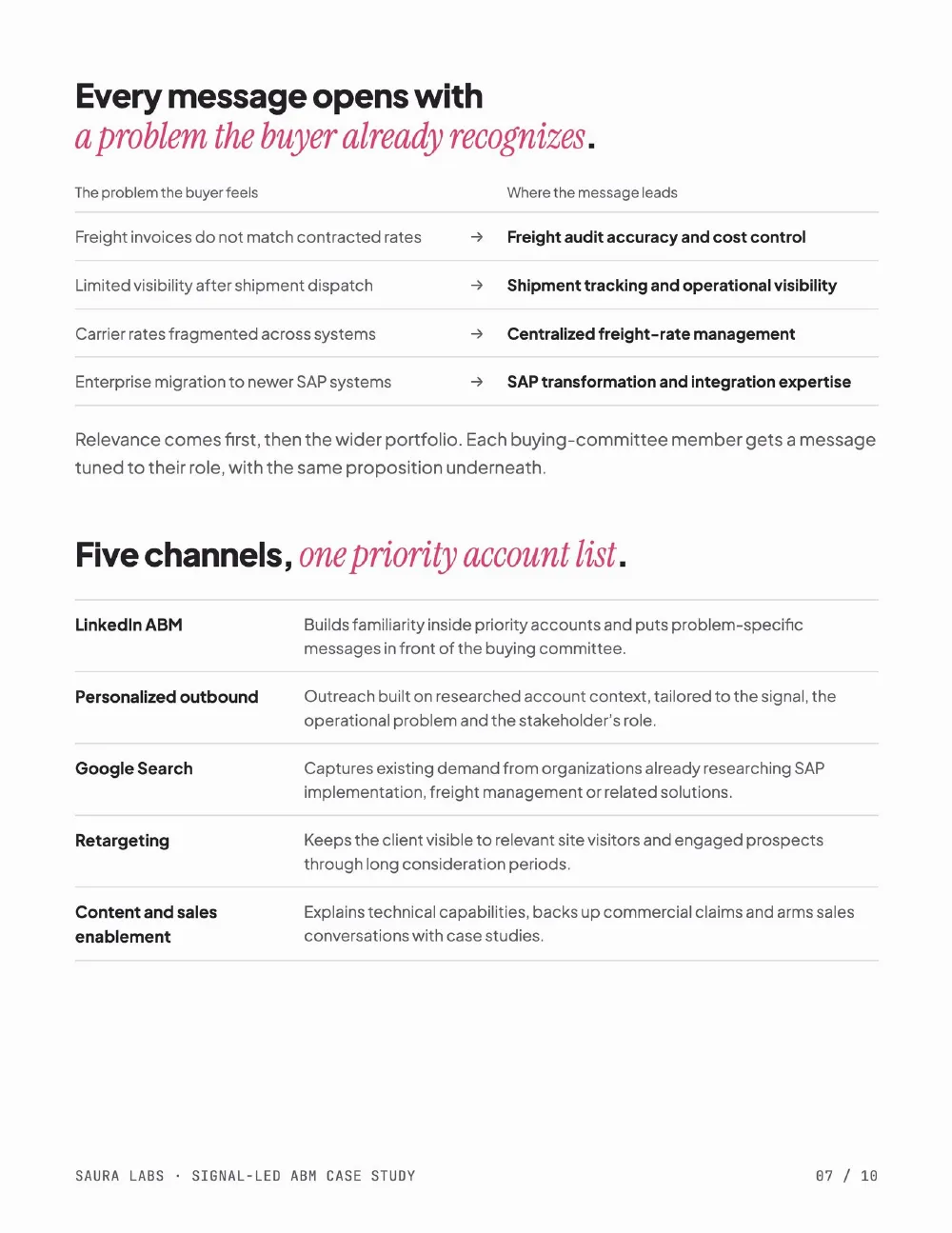
Every message opens with a problem the buyer already recognises
| The problem the buyer feels | Where the message leads |
|---|---|
| Freight invoices do not match contracted rates | Freight audit accuracy and cost control |
| Limited visibility after shipment dispatch | Shipment tracking and operational visibility |
| Carrier rates fragmented across systems | Centralized freight-rate management |
| Enterprise migration to newer SAP systems | SAP transformation and integration expertise |
Relevance comes first, then the wider portfolio. Each buying-committee member gets a message tuned to their role, with the same proposition underneath.
08
Five channels, one priority account list
| Channel | Its job |
|---|---|
| LinkedIn ABM | Builds familiarity inside priority accounts and puts problem-specific messages in front of the buying committee. |
| Personalized outbound | Outreach built on researched account context, tailored to the signal, the operational problem and the stakeholder's role. |
| Google Search | Captures existing demand from organizations already researching SAP implementation, freight management or related solutions. |
| Retargeting | Keeps the client visible to relevant site visitors and engaged prospects through long consideration periods. |
| Content and sales enablement | Explains technical capabilities, backs up commercial claims and arms sales conversations with case studies. |
09
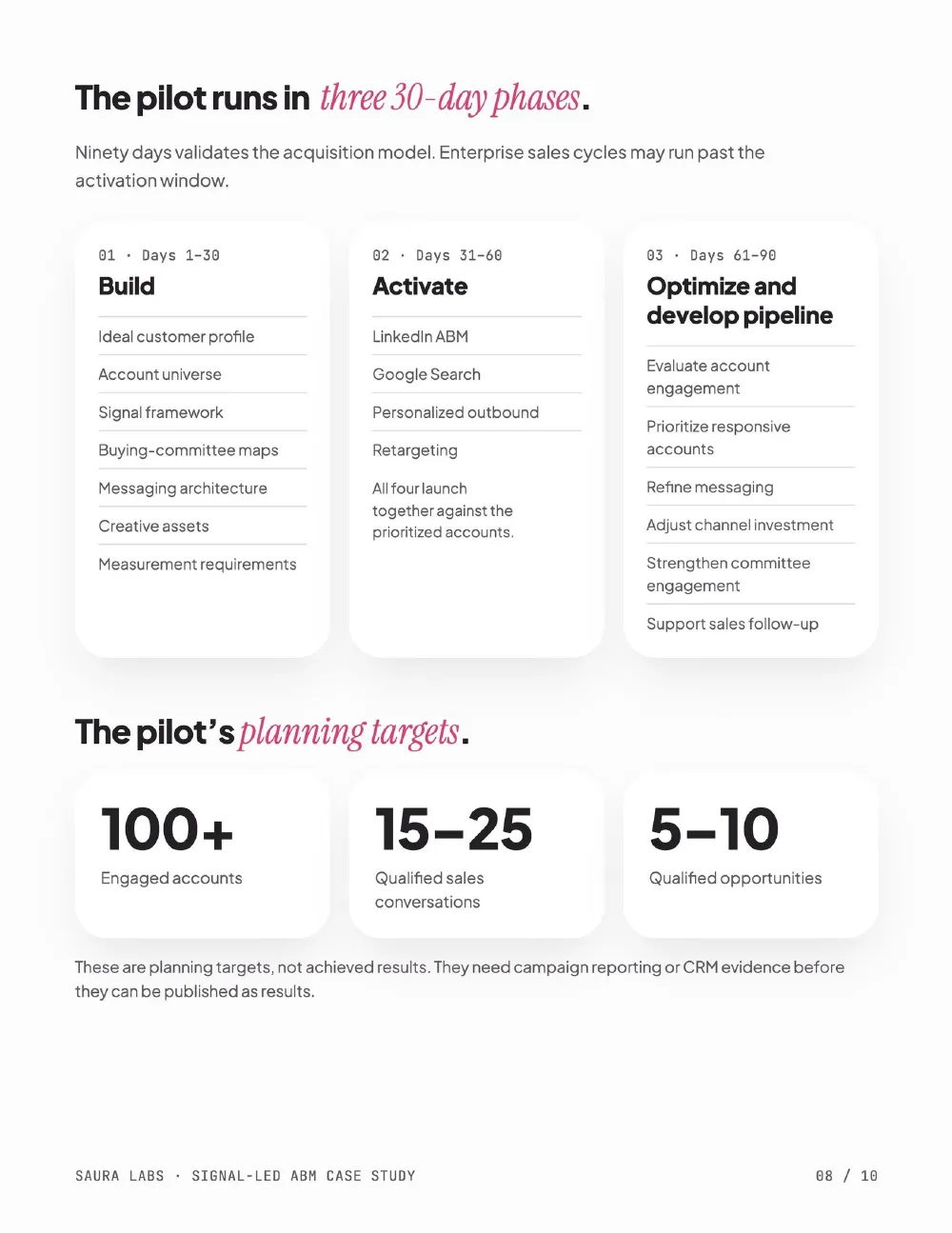
A 90-day pilot in three 30-day phases
Ninety days validates the acquisition model. Enterprise sales cycles may run past the activation window.
Days 1–30
Build
- Ideal customer profile
- Account universe
- Signal framework
- Buying-committee maps
- Messaging architecture
- Creative assets
- Measurement requirements
Days 31–60
Activate
- LinkedIn ABM
- Google Search
- Personalized outbound
- Retargeting
- All four launch together against the prioritized accounts
Days 61–90
Optimize and develop pipeline
- Evaluate account engagement
- Prioritize responsive accounts
- Refine messaging
- Adjust channel investment
- Strengthen committee engagement
- Support sales follow-up
- 100+
- Engaged accounts
- 15–25
- Qualified sales conversations
- 5–10
- Qualified opportunities
The pilot's planning targets, not achieved results. They need campaign reporting or CRM evidence before they can be published as results.
10
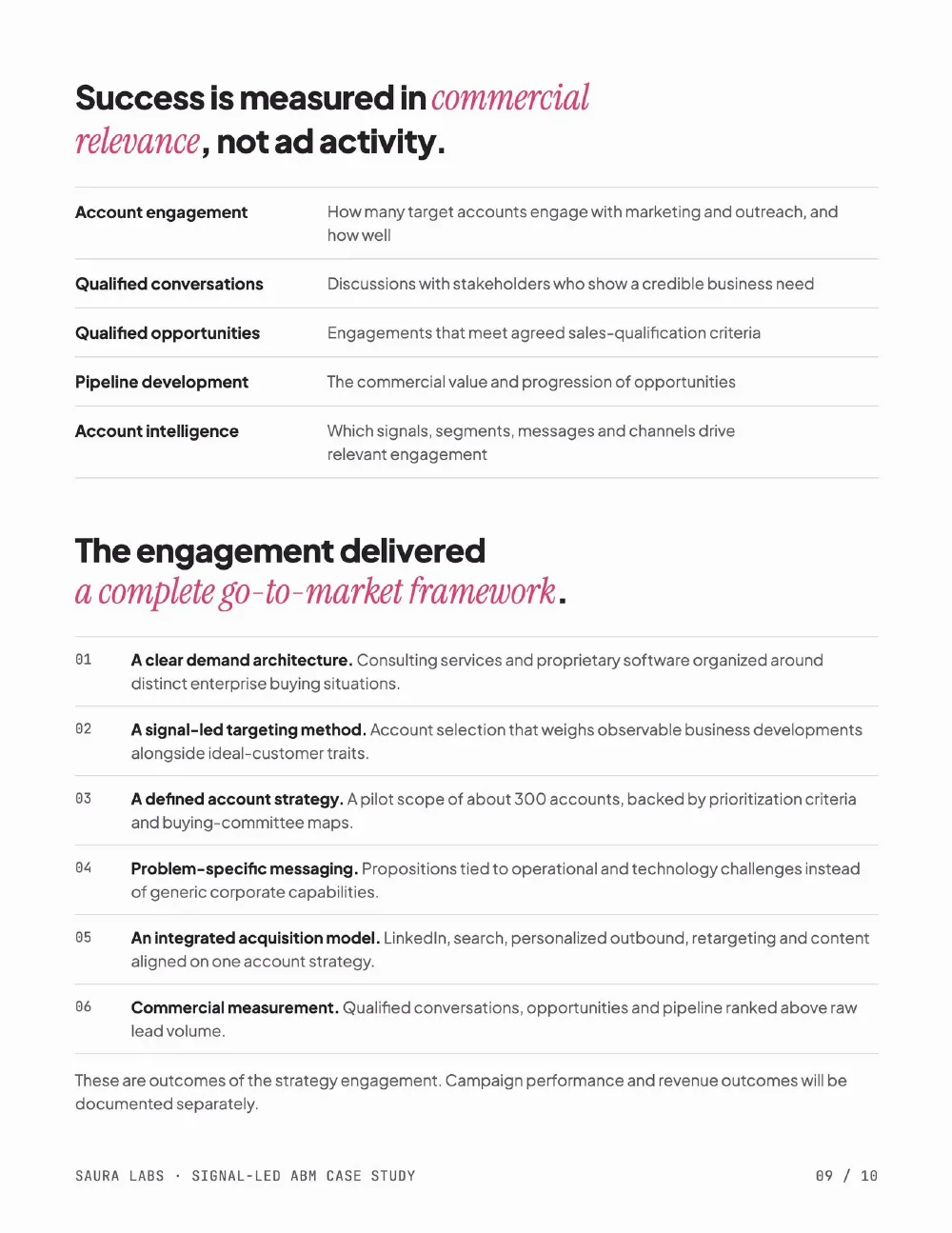
Success is measured in commercial relevance, not ad activity
| Measure | What it tells you |
|---|---|
| Account engagement | How many target accounts engage with marketing and outreach, and how well |
| Qualified conversations | Discussions with stakeholders who show a credible business need |
| Qualified opportunities | Engagements that meet agreed sales-qualification criteria |
| Pipeline development | The commercial value and progression of opportunities |
| Account intelligence | Which signals, segments, messages and channels drive relevant engagement |
11
What the engagement delivered
- 01
A clear demand architecture
Consulting services and proprietary software organized around distinct enterprise buying situations.
- 02
A signal-led targeting method
Account selection that weighs observable business developments alongside ideal-customer traits.
- 03
A defined account strategy
A pilot scope of about 300 accounts, backed by prioritization criteria and buying-committee maps.
- 04
Problem-specific messaging
Propositions tied to operational and technology challenges instead of generic corporate capabilities.
- 05
An integrated acquisition model
LinkedIn, search, personalized outbound, retargeting and content aligned on one account strategy.
- 06
Commercial measurement
Qualified conversations, opportunities and pipeline ranked above raw lead volume.
These are outcomes of the strategy engagement. Campaign performance and revenue outcomes will be documented separately.
12
The takeaway for B2B and SaaS teams
Effective B2B growth starts with knowing which organizations may need a solution, why that need is emerging, when to engage and who must be part of the decision.
ABM here is more than a LinkedIn targeting technique or a pickier form of lead generation. It connects market intelligence, positioning, messaging, channels and sales opportunity development into one acquisition system.